Happy Mother’s Day.

As someone who lost their mother quite early, I can empathise and acknowledge the worth of any woman in life. A mother do not have to be biological, instant or immaculate, just to be there is enough.

Mother’s Day.

A day to express appreciation for Mothers’ by giving them cards, gifts and spending time with them. It’s an opportunity to embrace the contribution mothers make to their families and society.

A common thread is to celebrate the role our mothers play in our lives and thank those who have had a significant impact on our lives. To be loved, Mother’s Day can be a joyous occasion built on positive memories. Expressing the love, you share for your mother only strengthens the bond.

Positive side.

Mothers should be valued and recognised for the support they give. The celebration can be a source of connection, joy and appreciation.

Mother’s Day can be a time when families share their experiences and strengthen the relationships, they have with family members.

Ways we celebrate Mother’s Day.

  • Express appreciation
  • Quality time together
  • Family gathering
  • Creative / DIY unions

However, it can be challenging for those who have loved and lost. Grieving can muster strong emotions sometimes laden with guilt, sadness. At this time, it is important to seek support from family, friends or mental health professionals.

Challenging for some.

On Mother’s Day it can be difficult for those facing mental health issues:

Relationships.

Relationships may have been difficult and at this time, people can suffer from heightened stress or emotional distress.

Infertility / Loss of offspring.

It can be a reminder of unfulfilled hopes of motherhood for some. It might bring back a traumatic memory of a miscarriage or pregnancy loss. This will trigger all sorts of mixed emotions.

Social expectations.

Social media can lead to feelings of inadequacy or comparison. People who don’t often conform to traditional family structures or face challenges may feel the added strain.

Charged feelings of isolation.

Feelings of depression or anxiety are intensified in this period with individuals comparing themselves to others.

Social Pressure.

There can be the expectation on Mother’s Day that everyone must celebrate it in the same way. We must all take part in themed activities and spread happiness.

Mother’s Day can evoke very powerful emotions about present and past relationships. On one hand, it can muster feelings of love and appreciation but on the other can be a breeding ground for trauma, past experiences and unresolved issues.

What can we do?

Loss.

It’s important to acknowledge these emotions of grief, sadness and loneliness. A sensible move would be to seek support from a professional or family / friends who will understand. Share your feelings and be open with others about how you will support each other.

Acknowledge differences.

Understanding the different perspectives associated with Mother’s Day and appreciating it can be a mix of emotions for some. This includes being sensitive and not assuming before making unsuitable comments which may cause distress.

Self-care.

Mothers need to communicate their needs and set boundaries that people respect. Any celebrations on Mother’s Day should be adapted to the individual. Take time out for activities that soothe, calm and relax from the burdens of life.

Celebrate you.

Take a step back to uncover your strengths. Focus on the support, love and nurturing you provide for others. Highlighting the positive parts of your journey as a parent.

Avoid social media.

Take a break from social media, don’t judge yourself by others on these platforms. Limit the amount of time you spend sharing and comparing.

Reach out.

Communicate with others that support is needed and talk about your feelings to help process them. The level of well-being needs to be watched and important to prioritise your mental state during this emotional time of the year.

How we can support Mothers.

  • Allow mothers to openly communicate in a comfortable environment.
  • Share responsibilities so that Mothers don’t feel relied upon and exploited.
  • Offer emotional support and actively listen.
  • Reduce the stigma of someone seeking help. Normalise the need to go to therapy.
  • Increase and promote awareness and equip mothers with information on stress management.
  • Promote a work / life balance and support a healthy environment for women to spend time in.

Inclusion.

The celebrations should include non-biological mother figures or those who have influenced lives in a nurturing way.

An important point to consider is Mother’s Day is a complex and individualised event and people respond to it in different ways.

Unplugging from Technology.

Nothing about Gardening but useful tips when deciding to have a break from technics. Good suggestions me thinks…

A day devoted to DE plugging. Individuals disconnect from various technological devices and digital platforms. This event has grown in popularity due to the increasing dependency on technology.

The day plans to break away from screens, notifications and digital distractions and adopt mindfulness, reduce tensions, eye stress and strain. This should encourage us to connect with the world more and make more meaningful connections.

Often associated with Shabbat, the National Day of Unplugging encourages us to disconnect from use. Individuals are encouraged to refrain from work and connect with the world around them. It is an initiative to raise awareness and highlight the problems with excessive technological use. It seeks to promote a more mindful and balanced approach to our digital lives.

The technological revolution has increased its use than in previous generations and those who have grown up with digital are often addicted to it. Whilst being a gadget genius is handy, it can have some significant drawbacks – often younger people who have grown up with developments, aka digital natives find it difficult to disconnect. The technology is a fundamental part of their lives.

Reports that the effects of excessive technology can be damaging are often over-emphasised but there is evidence it can be damaging..

Reducing technology use has many benefits. Not only is the right direction for a better work / life balance it can have a mental impact on us too. By unplugging our devices we can:

  • Improve our sleep.

Avoid exposure to screens, or certainly electrical devices before bedtime. The blue lights can prevent us from having quality sleep.

  • Improve our relationship with ourselves.

Practice mindfulness. Become yourself and observe the present. If we are not preoccupied with notifications, we are more likely to involve ourselves in activities, experiences with others and face-to-face interaction.

  • Improve close relations.

Uninterrupted time with friends can strengthen personal connections. Without screens, we can enjoy personal connections and more meaningful relationships and deeper bonds.

  • Increase productivity.

Without emails, social media and actively being online, your energies will be focused on the task that you have achieving your goals.

  • Becoming more creative.

Distancing ourselves from the digital world can give us a mental reset and create space for new ideas.

  • Becoming more active

Being physically active can improve our mental health and unplugging gives us additional time to do this. It can reduce our stress and improve our mood.

  • Mental clarity.

We can become overwhelmed with information. So by reducing our exposure, we liberate ourselves from unnecessary data. Our brains can recharge and have a break from an overload.

  • Reducing stress.

Responding to emails can often be a taxing activity so a reduction in this sort of activity can lead to lower stress levels and overall calm.

Tips to unplug.

A good start is to create boundaries.  We can improve our general outlook and live more fruitful lives.

  • Activities that don’t need technology. Engage in outdoor activities, arts and crafts, music, reading and games that are not electronic.
  • Turn off your devices. Let the phone drain, turn off the computer and spend some time with family / friends.
  • Connect with family / friends. Participate in community events.
  • Review the day when it’s over and evaluate its merits. Look at the relationship you have with technology and see if you can create a better balance.

To get down with a digital detox there are easy steps to take.

  1. (Boundaries). Set specific times or days when you can disconnect from electrical devices. Define what devices are allowed and those that are not.
  2. Let people around you know what you have planned. Ask them to respect these boundaries.
  3. Make sure you choose activities that don’t include a keyboard or screen. Engage in active sports, go for a walk, or learn an instrument.
  4. Remove all electrical devices from your sleeping area.
  5. Use an analogue alarm.
  6. Use the time away from the devices to evaluate your dependency.

Observing a day away from devices cannot only liberate your time but your mind to. Taking a break from the screen means we can develop our inter-relationships with loved ones / close friends. Breaking free from common distractions can help us see life in the present and mindfulness and gratitude can help us be more appreciative of what we have. It can improve our focus and concentration when we avoid information overload by decreasing social media. Our brains are able to reset and we can look on from a different perspective.

Camellia

A long time ago, there were lovers that lived on the opposite ends of a river. They promised to meet when the camellia flowers bloomed. But it rained so much the boat couldn’t cross the river. So the two couldn’t meet, even though the camellia flowers had all bloomed. Let’s meet again. Before the camellia flowers wilt. Camellias can be associated with Romance but more so a sense boldness with its immaculate flowers and repleat habit.

(John the Apostle).

These plants are so alike but also have very different characteristics. They like the same medium, environment, treatment and possess the same characteristics. Well nearly.

Camellia flowers are not only beautiful but also rich in meaning and symbolism. With a history dating back centuries, these flowers hold significance in various cultures and traditions. Longevity and happiness mostly and are mostly used in weddings in parts like Korea. Rich in antioxidants they have been known to have medicinal qualities.

Gloria Sims, floristempire.

Camellia

Zoe Furniss 2023

CAMELLIAS

Camellias are woody shrubs. Large shrub / small trees that usually flower in spring to summer. C.japonica and williamsii x. However, there are winter flowering although not as many varieties, Find at C.sansanqua. Camellias go well with Hostas, Rhododendrons and Maples.

Conditions

Camellias can survive in shade, certainly winter flowering varieties but do like shelter.

After flowering you need to prune to restore vigour of growth and eliminate the plants from becoming woody. Camellias like an acidic soil and can be container or field based according to the space.

Camellias like to have water so not drought tolerant but do need a little food, not excessive though. Like grass, too much fertiliser or food can cause an adverse reaction.

Deadheading can prolong the flowering but also retain the Camellias trim shape. In spells of very cold weather, keep them out of the wind.

Prune only when there are signs of excessive growth. Regular pruning will affect the volume of flowers which bloom.

Disease

Camellias can often get fungal infection in the summer due to moisture and heat. Gall affects the Camellia short term, a shrivelling of leaves caused by a bacteria infection. These infected parts can be cut out. Another fungal infection, Petal Blight, again, no biological control. Good housekeeping can prevent it in future years. Take care to remove dead and diseased debris.

ROSES

Roses, seem to work in an cluster whereas one Camellia can stand alone, it is very much up to the aesthetics of the onlooker, Roses are to known to look very good with interspaced Catmint (catmint) and Lavender for an Arts and Craft look. How very English you might say!

Roses, seem to work in an cluster whereas one Camellia can stand alone, it is very much up to the aesthetics of the onlooker, Roses are to known to look very good with interspaced Catmint (catmint) and Lavender for an Arts and Craft look. How very English you might say!

There are exceptions to these observations. Some Camellia’s are more susceptible to cold an some Roses are more hardy. Camellias can cope in shade as Roses often can’t. When you do cut them back. Reframe and redesign with a shape in mind and always cut above a leaf node.

types

  • Shrub Roses – can be used a back drop, in a corner and ideal in adverse conditions. This includes wild, old fashioned and modern. Rosa Aphrodite (‘Tan00847’PBR) (S) needs full sun, shelter and protection in the colder months.
  • Tea / Hybrid Rose – often hybrid and grafted. Share the same characteristics of a standard. Cut out dead, diseased and damaged branches. The severity of prune depends on the spread you want but follow the direct maintenance – you can’t go wrong.
  • Climbing Roses – not all need lots of sun, just protection Rosa ‘Madame GrĂ©goire Staecheli – a vibrant, fragrant example that can take a north facing aspect. All types of soil. Exposed or sheltered. Rosa Gertrude Jekyll (‘Ausbord’PBR) perfectly scented but not so shaded, shorter in habit but still easy with growing medium.

The type of Rose relates to its habit and level of pruning required. The idea is whatever the habit to reduce enough to reshape but not there are no buds to follow. Use clean secateurs and cut correctly, the Rose will benefit.

Conditions

Roses prefer moist, sunny and humus rich soil. Surviving in light shade but not heavy. Sitting in water is not their thing either.

They do not tolerate being soaked so worth reconditioning soil if space is limited. This means anything that changes your medium. You might add sulphur to make it more acidic, chalk / lime to reduce it.

Organic matter to substantiate thin free draining soil and sand to make soil less waterlogged. Potting it on can be a solution since you can manipulate the soil.

Avoid areas that are exposed and the branches easily damaged. Open / rough wounds affect Roses more than other specimens. Wounds can easily harbour disease.

Some are mound forming Rosa ‘Carpet White’ needing full sun and a southern aspect. Or climbing Rosa ‘Climbing Iceberg” ideal for shady spots.

It’s about habit. Shrub Roses compared to standard need less cutting back pre.spring. You can remove dead, diseased and damaged to ensure the adverse conditions of winter don’t damage. Take to a third of their height and in spring if they bolt. The vigour of growth is being restored so energy needs to focus on regenerative growth. Roses usually have a scent (except white) so worth retaining as many flowers as possible.

PRUNE

Prune downwards so no water collects on the bud. Cut to a dormant bud. The kind of rose determines how far you prune but this 1st rule applies across the board.

PEST / DISEASES

Replant disease can occur when the specimen is planted in the same soil a former plant was in. This is mainly due to pathogens in the soil. Signs would be poor growth and evidence of the rose not establishing itself. Roots can also appear rotten. A lot of fruit trees can also suffer from this condition. Quince, Plum and Cherry for instance.

Which / WhyRoses, seem to work in a cluster whereas one Camellia can stand alone, it is very much up to the aesthetics of the onlooker, Roses are to known to look very good with interspaced Catmint (catmint) and Lavender for an Arts and Craft look. How very English you might say?Camellia
AppearanceOval, serrated, matt, dark green. Deep veined.Glossy green leaves. Coated in wax.
LocationGrow in warmer climesCooler temperature
ScentRoses tend to smell more unless whiteStatement plants
Purpose Fragrance, fruit, jams and jellies and teaOrnamental, landscaping and cut flowers
DefrokeMostly deciduous / semi evergreenKeep their leaves (Evergreen)
BenefitsBouquet. Love and affectionChinese Medicine
Zoe Furniss

Another interesting point are Roses which are not of true order.

Cistus – a Rock Rose – a drought tolerant Mediterranean shrub. It needs full sun but can handle poor soil. They don’t like being pruned and will not tolerate heavy, wet or too rich a soil.

And, a Hellebore - Christmas Rose. / Lentern – a low growing semi evergreen that tolerates partial shade, fertile soil and moderate moisture. However, this is another blog altogether.

Roses: Acid loving, smell, appearance, maintenance, aspect, choice, maintenance. Roses: “thorny, complicated and a bit messy.

Roses show a choice for love and affection. “I always send to my beloved every year”.

Camellias are: Acid loving, shady parts, little pruning, good in containers, no strong winds, chalk. Camellias are good in landscaping, green glossy leaves. Very much to make an impression . “The Camellia does so well each year. I am thrilled”.

CONCLUDING THOUGHTS

Roses and Camellias are versatile and decorative shrubs providing colour, scent and being inviting to wildlife. Every shrub needs to be pruned. Plants certainly need water, almost every plant needs food. But how much and how little is entirely up to you. Some are more time-intensive and very much up to how you spend your time skill. Roses smell. Camellias bloom.

On one hand, Roses offer a divine fragrance, Camellias the glossy leaves. Both acid lovers, enjoying rich soil. Camellias are slightly more straightforward to keep judged on the fact that little pruning is needed. Aspect / purpose / maintenance / scent / vigour / disease all play a part in the environment it will be in and what other neighbouring plant needs are.

Green in an instant.

In a previous article mow not grow, we examined the steps to seeding a successful lawn. It can take some months so if the availability is there and you’re not strapped for cash laying turf is a method to use. To turf a lawn takes no time at all and the effect is instant.

However, it is a little more complex and the staple rules must be followed. A good idea also is not to lay the grass in hot weather. This is largely down to shrinkage which will be mentioned later.

Assess your ground. The surface area. Calculate one roll to one square metre. Evaluate what soil you have. Does it get waterlogged, the likelihood is it’s clay-based. This needs to be treated as you will find it difficult later to maintain (puddles in wet weather, soggy areas.) Does it dry out quickly, then it’s sandy. Again, difficulties in summer (patchy brown and little growth.) Grass can also be susceptible to disease and pests when it’s weakened.

The treatments to alter the soil are logical. If it is clay-based, you will have to break the soil up which can take time. You will eventually want fine soil on the back of a fork until the particles are broken. Walk the site with your feet stamping on the clumps of earth. A garden rake then applies pressure in a backward / forward motion until it’s a very fine tilth. It may even be an idea to filter some sand as well to make it more free draining.

If it’s sandy-based, you will substantiate the quality and bulk out the soil. This is achieved by adding organic material or screen soil (low quality) / topsoil (high quality). All these factors are important, it’s all in the preparation.

The level of ground is important and lulls and bumps should be eliminated or any unwanted unevenness.

The question of where to buy your turf is crucial. The turf stays fresh for up to 3 days. It should have been cut on the morning of delivery. This is relevant when you work out the likelihood of it being successful. Old turf is a false economy. So, make sure it’s fresh. Keep them in rolls as you start to work backward.

Do.

  • Work backward and don’t return to the laid area.
  • Use a plank to tamper the joins /lay the turf side by side overlapping where you knead it with a rake.
  • Large pieces of turf around the outside.
  • Use offcuts only in the middle or sparingly.
  • Have a surplus for wastage (10%).
  • Regularly water even in colder periods.
  • Mow very high for the 1st time.

Don’t.

  • Walk on the site.
  • Mow until 2 weeks after showing signs of success.
  • Leave any small gaps (the turf will shrink and sink as it is knitting together.
  • Interfere with area.
  • Use small pieces or avoid damaged / imperfect rolls.

Buying your seed is easy. There are several kinds available for different purposes. There is even shade-loving seed which before had been a common problem. Turf usually needs to be bought from a reputable firm to ensure the quality (Amenity.) Fine turf (fescue and meadow but with ryegrass.) Well, you don’t want to make life more difficult.

It takes more energy / more money / more focus but is certainly quicker to initiate. Seeding takes longer but is cheaper. You can do it all times of the year bar high summer. Seeding can often be laborious and sometimes the seed fails. Not for any error just because nature is volatile. It’s up to you how quickly you want it.

CHILLY AND DARK

There is always an isolated spot in an open space that is shaded. Aside from woodland bulbs (Crocus / Bluebells) and perennials (Astrantia / Acanthus) there are some shrubs that prefer this aspect. Some are winter flowering so for dark and cold spots. It can be used to create a biodiverse paradise too. With some moisture and a bit of humidity fungi, ferns can be encouraged. It’s not so much the shade that affects them it’s the lack of water if anything.

Sarcococcoa (Christmas box) An evergreen often used a shrub but can be made into a hedge (mound forming). It provides white fragrant flowers in late winter. The fragrance is delicate notes of vanilla – sometimes referred to as sweet box too. The shrub has attractive foliage, can cope in shade although must be fertile and have substance. If it does get sun the soil must be kept moist.

Virburnum bodnantense “dawn.” A winter flowering shrub, be mindful not a neat one, no formal habit. It is very hardy though. It can be pruned to keep compact but taking away its character really. It flowers in winter and bears berries in summer. It loses its leaves in flowering but provides interest all times of the year. It flowers in winter through into spring. Virburnum tinus offers the same amount of colour, scent, leaves but is evergreen and flowers with its leaves. It prefers a sunny aspect. The soil needs some fertility too and have substance.

Mahonia A winter flowering shrub. An evergreen too with very attractive foliage, a vibrant yellow burst of colour. Its habit is slow growing so it keeps its shape very well. X media ‘charity’ and X media ‘winter sun.’ They are both slightly different. No maintenance to speak of. Mahonia needs a little shelter so not great in an exposed position but very straightforward otherwise. The shrub is very hardy offering attractive foliage, berries, flowers and fragrance. What more?

Ferns are usually very good in shade. They’re probably one of the oldest plants – prehistoric in fact. Some in damp shade, some in dry. Dryoptens erythrosora is an interesting type since it offers a copper glow along with pretty fronds like ferns have. Multiply on their own. Survive and adapt in the most adverse conditions. A woodland habit so under trees; poor soil; little nutrients; source their own moisture but I think a little humidity help is needed. Incredibly resourceful.

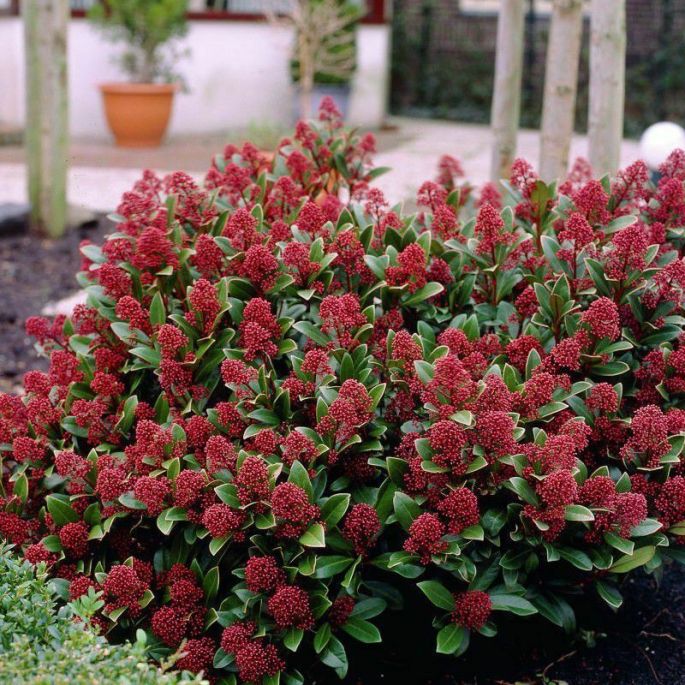
Skimmia japonica. A great evergreen, wonderful in drifts. Quite straightforward to maintain. It can become leggy and only produce at the top of plant so pruning periodically of unwanted growth can help this. This seems to happen in time. They are quite slow growing so not very often. It provides fragrant white flowers and berries in spring. you’ll get berries if you put a boy and girl next to each other.

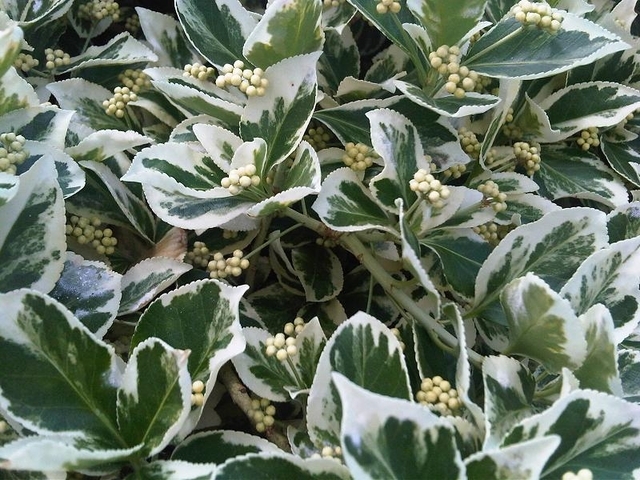
Euonymous alatus is a decidious E. It offers wonderful red foliage in the autumn. Burning bush to most would be considered a specimen shrub although in some states it is regarded as invasive and a pest. It does produce berries but known more for its foliage. A little bit on the wild side though. There are Euonymous that are evergreen, have a different habit and offer different foliage. These usually have more compact habit as a shrub although there ground cover and climber varieties. The foliage is usually variegated and often cream and green E. ‘Emerald Gaiety’ and green and yellow ‘Emerald n Gold’ and ground cover ‘Colorado.’ Euonymous’s are great foliage plants. Low maintenance in any aspect. No pruning save unwanted growth. They are very resilient and often overlooked.