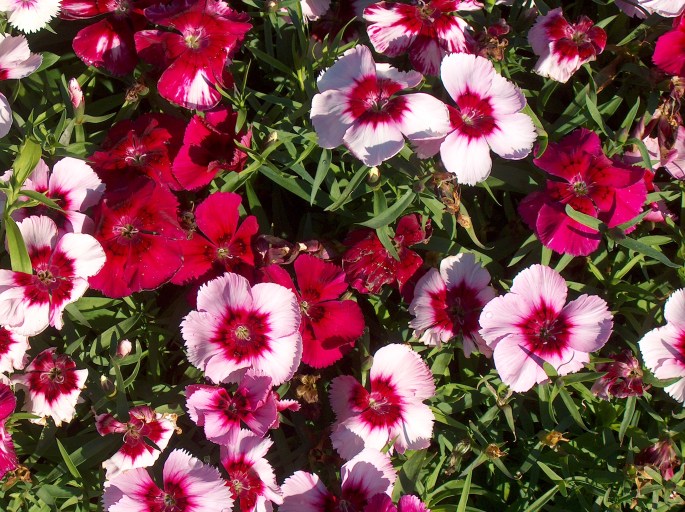
Ground Cover For Cracks

Instead of pointing the cracks of a path or wall, extraordinary results can be achieved by filling the void with flowering ground cover plants. A carpet of colour can substitute the most boring of bricks or paving.

In one pot sits a number of plants, only a small amount of piece of fiborous root is needed to be tucked under the surface. Under the right conditions it will root itself and the rest is done. A small amount of soil is needed perhaps within the cracks but only as a root zone. Some species may even be able to cope with a gritty composite of almost no humus rich matter. It will live off the minerals of rocks nearby.

White flowers include – Thymus serpyllum ‘Snowdrift’ – a creeping thyme. Iberis sempervirens – good as foliage and flowers in spring and summer. Cerastium tomentosum – fantastic grey foliage and white flowers – a spreading habit throughout spring into summer. Saxifraga sancta – a true alpine that draws its goodness from the stones around it. Erigeron karvinskianus – providing pink and white ground cover for months.

Pink flowers – Chamomile ‘Treneague’ – effective in sun and shade, gives off an aroma when bruised. Dianthus deltoides ‘maiden pink’ – highly scented, late spring to summer of white, red or pink. Thymus praecox ‘Coccineus’ – pink to red flowers, mat forming and highly scented.

Red flowers – Dianthus deltoids ‘Flashing lights’ providing a striking show from late summer to autumn. Portulaca (moss rose) too provides an assortment of colours including red, orange, white although can be a bit particular about their environment. Must be in full sun and in sandy, free draining soil but at the same time cannot withstand really dry periods, because of their size and habit care must be taken when watering as the flowers can easily be damaged.

Blue Flowers – Aubretia – ‘Blue carpet’ – from spring to summer provides a carpet of blue to violet flowers, deadhead to thicken growth. Cornflower ‘Trailing Blue Carpet’- to prepare for following year indoors or sow in spring outside, mat forming and trailing annual. Geranium ‘Rozanne’ – repeats of blooms throughout summer, but may need a substantial root zone in humus rich soil. It has a relative ‘Johnson’s blue’ but the blooms are not as striking and its habit needs more attention to control. Veronica x ‘Blue reflection’ – a spring flowering ground cover plant crossed with parenting plants for it’s resilience and flowering habit.

Purple flower – Vinca minor – a carpet forming late summer to autumn flower. Vinca major, a relative has the same showy flower but larger and more invasive. Good for shaded neglected spots. Verbena Tapien ‘Purple Passion’ and ‘Blue Violet’ provide flowers throughout spring and summer forming a dense cover to any bare spot. The hybrid ‘blue violet’ requires no deadheading and is extremely low maintenance. Primula tyrolensis – a dwarf flowering primrose. This flowers through winter and often in poor soil but doesn’t like being wet and prefers some shelter in well drained soil. Campanula poscharskyana ‘Blue Waterfall’ flowers from late spring to summer proving to be popular with beneficial insects and requires no maintenance.

Winter Interest

This piece provides information on small trees/large, small shrubs that most of the year round may seem non-descript but it’s the autumn they come into their own.

Cornus alba ‘Sibrica’, a startling red bark in the colder periods but attractive white flowers in the warmer months. Some, Cornus mas yield a fruit shortly after foliage but you wouldn’t want to eat. Having said this, they look very attractive so may well be a food source for bio diverse wildlife.  For another purpose, Cornus ‘kousa’ var chinesis provides beautiful autumn foliage and subtle white later pink flowers in summer.

Another example would be Witchazel, namely, Hammamellis mollis x and Hammamellis x intermedia. These are hardy, frost resistant examples of splendid winter colour, they have a twisted branch habit with vibrant feathery flowers. Fantastic as a backdrop in a winter landscape.

A particularly valuable specimen for flowers and scent that can be found in winter is Chimonanthus praecox. Its common name being ‘wintersweet’ – an accurate definition of its traits. It provides autumn flowers and then foliage with no flowers in the warmer months. However, it produces heavily scented blooms borne on purely branches.  It needs, however, other similar flowering specimens around it. Other than its flowers and the oils it emits it has no other attributes.

You wouldn’t equate winter with Honeysuckle although there are varieties that flower in the autumn months. Lonicera x purpusii (an offspring of Lonicera fragrantissima). These not only give off a fragrance but can give an impressive flowering period between November and March. These also form on bare branches but does bear leaves through the non-flowering season. In this instance, good as a backdrop when other specimens at the front lie dormant and vice versa. Another benefit is they’re quite tolerant of windy or exposed settings and do not require protection as some climbers do. They provide a pollen source for beneficial insects that need support short of spring. However, these are quite large and can spread to an invasive size and so would be suited to a larger garden since no pruning is necessary and they should be left to their natural habit.

Mahonia x media ‘Charity’produces a full array of yellow flowers and can set off any shaded part of a garden. It can be in full sun but a little shade might be more desirable. The flowers are scented and will flourish from late autumn to early spring.  Both the foliage and flowers are impressive on their own and you benefit not just from aesthetics but also a fresh, vibrant fragrance which is certainly a pick me up in winter. It should be pruned straight after flowering otherwise it will affect next year’s growth. It will thank you to since the habit can also become straggly if left.

For the smaller garden or surburban space where room is scarce, Skimmia japonica can provide an all-round interest. They do prefer to be in partial shade so as not to get scorched and will benefit from being in well-drained soil.  Another benefit is they can be containerised or sit in the ground. The male form will produce red buds (not berries strictly) ready to unfold to give creamy – pink flowers, fragrant flowers throughout spring.

Hellerborus orientalis is another reminder of spring being imminent yet still enjoys frost – bitten mornings. When many things are asleep the Lentern Rose is anything but.  Not petals as such but a cluster of cup – like sepals adorn a very attractive dark, bold green serrated leaf. They are not keen on sitting in very moist environments but any other conditions they are very versatile and adapt well. They are frost hardy and have a “spring in their step” when some things are still underground!

For the flat/apartment balcony or ledge cyclamens are ideal and can be maximised to brighten any windowsill up. They don’t like getting too hot and don’t require a lot of water, just pull off spent flowers and another will form. You don’t need to submerge the crown (corm organ) and they generally are maintenance free. There are varieties that can be grown outdoors or in extension rooms.